


Capers - Capers in vinegar
Caperberries in Vinegar – Alcaparras from Spain The Alcaparras –…
Couldn't load pickup availability

- Excellent Ratings
From 250,000 happy customers - Fast Customer Service
by phone, email, or chat - Family-owned since 2002.
only good things: our name – our philosophy.
Shipping & Delivery
Your order will reach you in just 1-2 days with DHL, DPD, or UPS for as little as €5.45. Shipping is free on orders over €99. Need it faster? Choose from our express shipping options.

Payment and Installment Plan
Your payment information is always processed securely. Choose from many payment methods such as PayPal, Klarna, Apple Pay, Mastercard or Visa and benefit from purchase on account and installment payments. You can find more information in our Payment Terms.
Questions about Capers - Capers in vinegar?
We are happy to help you with Alcaparras Asensio Sanchez.
Caper berries in vinegar from Murcia, Spain
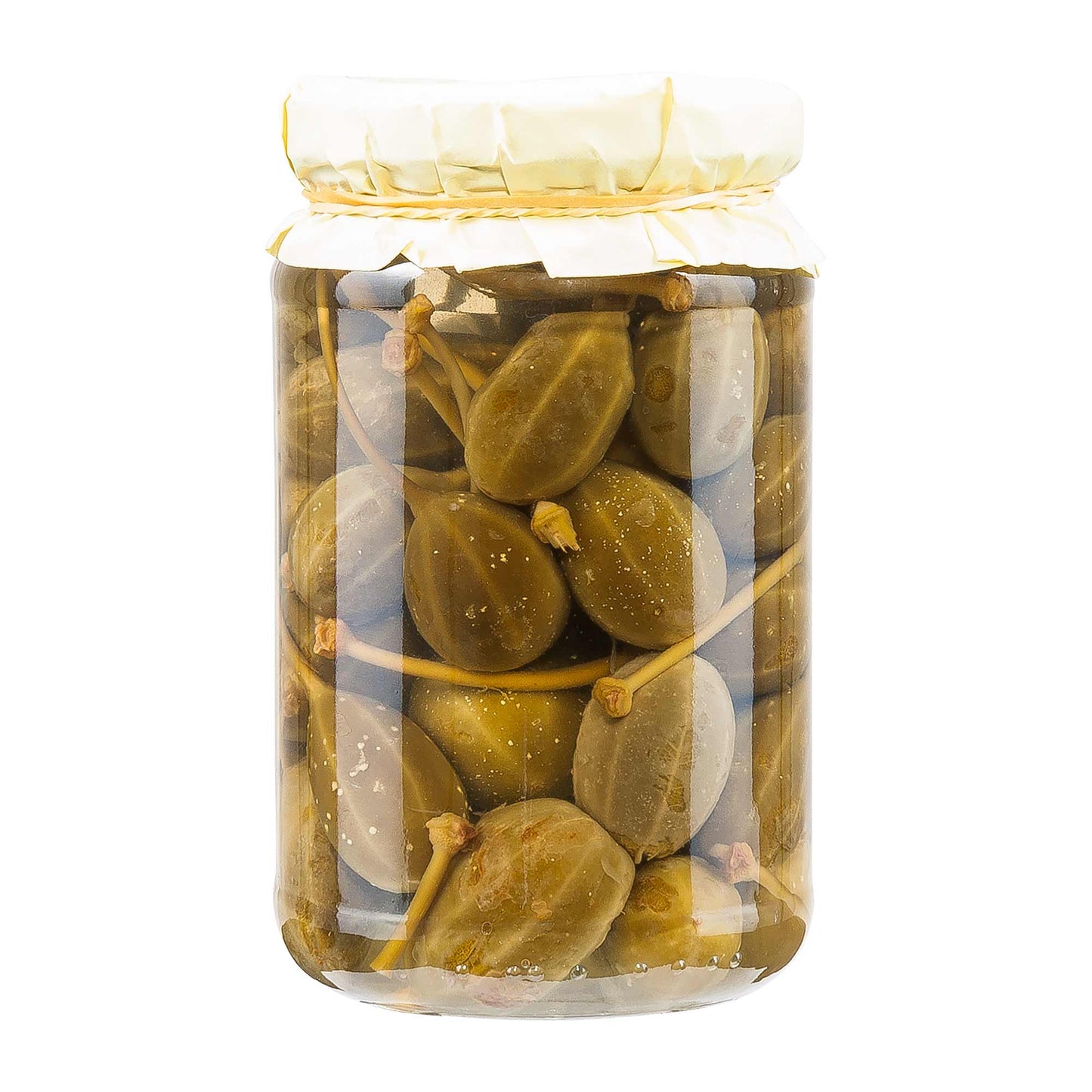
Caper berries are the fruits of the caper bush, not its buds. They are harvested with the stem, pickled in a salt-and-vinegar brine, and eaten like olives rather than used as a spice. These ones come from Almendricos in Murcia, where the bush grows without irrigation.
The caper berries in vinegar from Alcaparras Asensio Sanchez come from the southern Spanish region of Murcia. Four ingredients are listed on the label: caper berries, water, salt, and vinegar. The brine removes the fruit's bitterness and adds a subtle acidity, making them perfect to eat straight from the jar. The stem remains attached, which is more practical than it looks.
Why the berry has a stem
Caper berries, also known as caper apples, grow from the blossoms that were allowed to remain on the bush.
Anyone picking the closed bud harvests the small caper, which is used as a spice in sauces and broths. If the bud is left on the branch, however, it opens into a white flower, is pollinated, and grows into a fruit. This is harvested together with the stem by which it was attached to the bush, and that is exactly what you hold on to later.
In the jar, the berries lie packed tightly in the brine, olive-green, plump, and with a light longitudinal grain from the stem base to the tip. On the tongue, they are crunchy, sour, and salty all at once. Their bite is firmer than that of an olive and softer than that of a gherkin, and the small seeds inside are eaten along with the fruit.
Salt and vinegar instead of preservatives
The caper berry goes into the jar without any preservatives because salt and vinegar do the work alone.
In Almendricos, the fruits are sorted by size after harvesting, washed, and placed in the brine. There, they lose their raw edge over weeks and absorb the acidity. What starts as a bitter, tart fruit from the bush becomes mild enough for pure enjoyment, while retaining the herbal note peculiar to capers.
They are sorted by size, from the delicate Fino to the robust Gordo, and only one size grade goes into each jar. This ensures that the berries cure evenly and present a uniform appearance when opened.
The company has been working with this fruit for four generations and is internationally known for the soft texture of its caper apples. You can read more about the family on the Alcaparras Asensio Sanchez page.
From aperitif to Vitello tonnato
Caper berries are used differently than small capers; they don't season, they are eaten.
Lifted from the jar by the stem, these caper berries in vinegar belong on an appetizer platter just like olives and almonds; in Spain, they are skewered with olives and chili peppers on the "Gilda" pintxo. Sliced into a salad, they provide acidity; paired with cold roasts or thinly sliced veal, they are a classic accompaniment, such as in Vitello tonnato. You can find suitable pairings under Antipasti and Mediterranean specialties.
They also hold their own in stews and Sicilian caponata because they do not fall apart during cooking. If you want to distribute them more finely, slice them lengthwise into strips and add them just before serving.
Once opened, the jar will keep in the refrigerator for several weeks, provided the brine covers all the berries. If one sticks out, it will dry out, which is why it is worth taking a moment to use a spoon. Further jars of this type can be found in the Capers and Caper Apples category.
370 g net weight – 180 g drained weight
Alcaparras Asensio Sánchez
Alcaparras Asensio Sánchez
Nutritional Information
Nutritional Information
Alcohol content
Alcohol content
Ingredients
Ingredients
Distributor
Distributor
Statutory Warranty
Statutory Warranty

nur Gutes: Your gourmet delivery for delicacies and wine since 2002
How it all began: A passion for good food
Do you know the feeling? You come back from holiday with a bottle of olive oil from Portugal in your suitcase, a jar of fruit spread from South Tyrol, perhaps a bar of chocolate from a small manufactory in France – and you ask yourself: Why can't I simply get this at home? We asked ourselves exactly the same question. Again and again.
We are Kerstin and Stephan Uhlenbusch from Nordhorn, a small town on the German-Dutch border in Lower Saxony. We have always loved good food. On our travels through Europe we made the most wonderful culinary discoveries: mountain apple juices from the South Tyrolean highlands, Breton churned butter, handmade pasta from Italy, French sea salt and much more. It was never the big luxury products that fascinated us, but honest, artisan food made by people who stand wholeheartedly behind what they make.
In 2002 we decided to turn this enthusiasm into our profession. We wanted to make good food available to as many people as possible – not only to those lucky enough to buy directly from the producers. That is how nur Gutes came about, first as a local delicatessen in Nordhorn and soon afterwards as one of the first gourmet online shops in Germany.
Our name is also our philosophy: nur Gutes means "only good things". Full stop.
Who we are: Delicatessen merchants, food lovers, industry insiders
What sets us apart from many other online shops is not only our range, but above all our expertise and our network. Kerstin was managing director of the association of leading delicatessen merchants in Germany – the trade association that brings together the country's best owner-run delicatessens. In this role she did not just follow the German delicatessen trade, she actively helped to shape it. With the deli Festival we also founded our own B2B trade fair for delicacies, which for years brought together producers, retailers and restaurateurs from all over Europe – a culinary salon of the highest order.
Through these many years of work at the heart of the German delicatessen trade, we have built a unique network – of producers, retailers, restaurateurs and food artisans from all over Europe.
What does that mean for you as a customer? Quite simply: we know our trade like few others. Over more than two decades we have built relationships with small manufactories and passionate producers – directly, personally, as equals. Chambers of commerce and economic development agencies from all over Europe regularly introduce us to new and exciting producers who want to bring their products to the German market. This network allows us to offer you products you won't find in any supermarket and in hardly any other online shop.
Our range: Fine food, wine and delicacies from all over Europe
In our gourmet delivery service you will find a lovingly curated range of fine food, delicacies, wines, non-alcoholic drinks and selected kitchen and home accessories. We carry around 8,000 items from manufactories and producers in Germany, Austria, Italy, France, Portugal, Spain, England, Iceland, Denmark, Sweden, Greece and the USA.
Our fine food range stretches from exquisite basic ingredients to very special treats. Whether you are looking for a high-quality extra virgin olive oil from Portugal, genuine Aceto Balsamico from Modena, fleur de sel from the Breton coast or handmade spice blends – you will find it here. The range also includes fine fruit spreads and jams, aromatic honey, truffle specialities, chutneys and mustard sauces, first-class tinned fish such as vintage sardines and tuna, risotto rice, handmade pasta and much more.
Our chilled delivery brings you delicacies such as the legendary Beurre Bordier from Brittany or the finest salami from Tuscany and South Tyrol straight to your door – securely packed and chilled.
Wine, sparkling wine and champagne from winemakers we know personally
Our wine range is especially close to our hearts. In the nur Gutes online wine shop you won't find wines from all over the world, but from winemakers and estates we have visited personally and whose work we value. Wine is a matter of trust, and we pass this trust on to you. Whether white wine from Rheinhessen or the Palatinate, red wine from Austria or Burgenland, rosé for the barbecue season, natural wine for the curious or sparkling champagne for special moments – here you will find quality we stand behind with our name.
Many of our winemakers work organically or biodynamically. We accompany them on their way and are glad to pass this development on to our customers. Because good wine can taste excellent and still come from organic or biodynamic vineyards.
Our philosophy: Hand-picked quality instead of mass-produced goods
What makes a product a nur Gutes product? We ask ourselves this question for every single item we add to our range. And the answer cannot be reduced to a single factor – it is a combination of craftsmanship, origin, ingredients and the passion of the people behind it.
We ask a lot of questions before a product finds its way into our shop. How is it made? Where do the raw materials come from? What philosophy does the producer follow? How limited is its availability? We quickly notice whether we are hearing marketing phrases or whether a producer is delighted to explain their journey and why they do what they do the way they do it. This is exactly the enthusiasm we look for – and we find it again and again in the people behind our products.
Our quality criteria can be summed up like this:
Artisan production: We prefer products from small manufactories and family businesses that often have been making their culinary treasures by hand for generations. You can taste the careful processing and craftsmanship in every bite.
The best ingredients: For us, quality begins with the raw materials. Whether fruit, vegetables, milk, meat or grain – we make sure our producers rely on first-class ingredients that are as natural as possible.
Origin and regional identity: We value products with a clear regional identity. A South Tyrolean mountain apple juice made only from slowly ripened, old apple varieties. A Portuguese olive oil from trees that have shaped the landscape for centuries. These stories of origin make delicacies what they are.
A personal relationship with the producer: Wherever possible, we buy directly from the producer. We have known many of our suppliers personally for years, some for more than two decades. We visit them, taste together and exchange ideas. This closeness matters to us because it ensures transparency and trust.
And of course: taste. At the end of the day, it has to taste good. We try all products ourselves – not just with a spoon when they are new, but again and again while cooking, at the table, on the plate. Only what convinces us, what we can call "nur Gutes", makes it into our shop. Our quality begins where the supermarket ends.
Producers, packaging, food: What we pay attention to
Regional origin, small businesses and a direct line to the producers have shaped what we put into our range since 2002.
Behind this is respect: for the raw materials, for the people who produce our food, and for the animals. This respect shows in many small and large decisions we make every day.
When choosing our products we look closely at how our producers work. Many of our producers are certified organic. With the others, we ask directly how they grow and produce.
For shipping and packaging we use paper instead of plastic wherever possible. We ship your order safely and unbroken – a real challenge with a range that stretches from wine bottles and bags of crisps to jam jars and cookware. We cushion with packing paper: more than 9 out of 10 parcels leave our warehouse without any plastic padding.
Against food waste we take active steps. Products with a short best-before date or slightly damaged packaging are offered at reduced prices in our sale section. Because "best before" does not mean "bad after" – and it would be a shame to throw away carefully made fine food. Become a food saver and perhaps discover your new favourite product along the way.
The people behind the products: Our producers
What gives us the greatest joy in our work is being able to accompany true enthusiasts on their way. People whose drive is to make a good product even better. Some of them have been with us since we started – for more than twenty years.
There is Thomas Kohl with his unique mountain apple juices from South Tyrol, made from old, slowly ripened apple varieties. Stefan Gruber and the wonderful Alpe Pragas fruit spreads. Stéphane and his Bonnat chocolates from France. Antonio Duarte of Monterosa and his outstanding Portuguese olive oil. Christina of Il Borgo del Balsamico. Johan Bülow and his famous Lakrids. Uwe König from the Bergisches Land, who makes fruit spreads, mustard and chutneys in small batches with his wife in their Königskind manufactory – just like homemade.
These are just a few examples among many. Behind every product in our shop there is a person, a family, a story. And it is precisely these stories that make the difference between an interchangeable food and a true delicacy.
Your shopping experience at nur Gutes
We know: buying fine food online is a matter of trust. That is why we do everything we can to make your purchase with us a thoroughly positive experience.
Personal advice: We are not an anonymous platform. Behind nur Gutes are real people you can reach whenever you have a question. Whether you are looking for a special gift, want to know which wine goes with the menu you are planning, or need advice on a particular product – we are happy to help, and with enthusiasm.
Safe packaging: With more than 20 years of experience in gourmet shipping, we know exactly how to bring even the most delicate products safely to your home. Wine bottles, jars, bags of crisps and cookware arrive as they should: undamaged and ready to enjoy. Our delivery accuracy is 99.9 percent.
Fast shipping: We ship your order quickly and reliably. Within Germany, shipping is free for orders of 99 euros or more.
Trusted Shops certified: Your security matters to us. Our shop is Trusted Shops certified, and you can pay conveniently by invoice, PayPal, credit card, Klarna or bank transfer in advance.
Gifts and hampers: Looking for a special gift for someone who loves good food? We put together individual gift baskets and presents – for every occasion and every taste. From a small token to a generous gourmet gift: you will find the right thing here.
From local shop to gourmet delivery: How we have grown
In the more than 20 years since we started, a lot has changed – and at the same time much has stayed the same. Our standards of quality, our passion for good food and our personal approach to customers and producers are the same today as on the very first day.
What has changed is the way we work. The delicatessen in Nordhorn's town centre has become an online shop shipping throughout Germany, with a modern company building. In our warehouse we organise around 8,000 items efficiently and systematically, so that your order reaches you quickly and correctly. But our shop in Nordhorn is still there too – if you are in the area, come and visit us. Here you can discover and taste products and get personal advice.
Over all these years we have learned what quality really means. What makes a fine food product special, in how it is made and where it comes from. This knowledge goes into every single item we choose for you.
nur Gutes – because you only find good things here
Whether you want to order fine food online, are looking for a special wine, want to put together a gift for someone you love or simply want to enrich your kitchen with high-quality ingredients: at nur Gutes you are in the right place.
We look forward to taking you on a culinary journey of discovery. Through our range, which brings together the best manufactories in Europe. Through taste experiences that enrich everyday life. And through the certainty that behind every product there is a story worth telling.
Browse our gourmet delivery service, let yourself be inspired and have your favourite products delivered conveniently to your home. Because in the end it is all about one thing: enjoyment.
A warm welcome to nur Gutes.
Kerstin and Stephan Uhlenbusch

-
 Vendor:Alcaparras Asensio Sanchez
Capers - Capers in vinegar
Caperberries in Vinegar – Alcaparras from Spain The Alcaparras –…
Content:Regular price 5,40€Sale price 5,40€ Regular priceUnit price 30,00€ per kg5,40€


