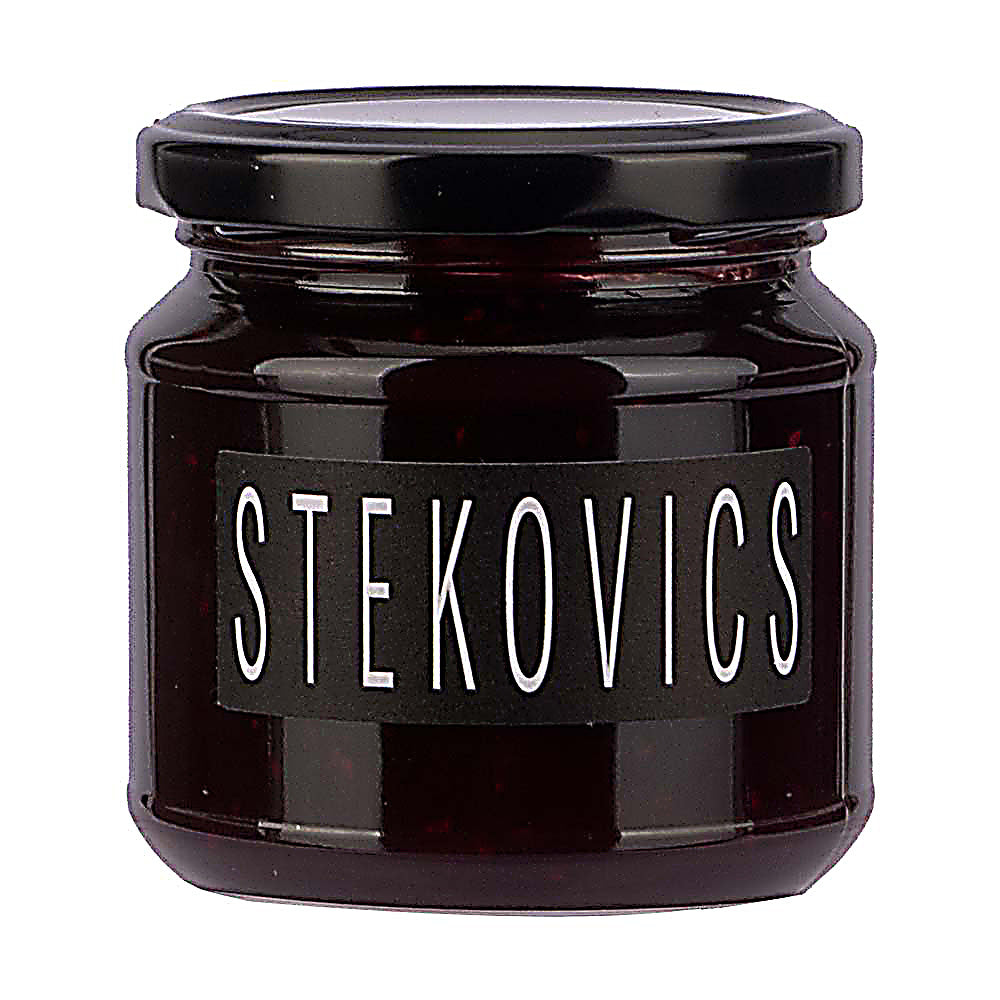
Mulberry Fruit Spread from Erich Stekovics with Mirabelle Plums
Mulberry fruit spread from Erich Stekovics combines dark mulberries with mirabelle plums, the small yellow wild plums from the edge of the field. Two fruits that are practically non-existent in retail because both are too soft to survive a crate and a night in a truck.
Mulberry fruit spread is a dark mulberry jam by Erich Stekovics from Burgenland on Lake Neusiedl, cooked from mulberries and yellow mirabelle plums with a 70 percent fruit content. The spread stands firm on a spoon in the jar, whole pieces remain visible, and the color is a deep blackberry red.
Honey-sweet berry and tart wild plum
The mulberry brings a soft, almost honey-like sweetness that would quickly become cloying on its own and therefore needs a counterpart. The mirabelle plum provides this with a clear, tart acidity that gives the spread its kick.
On bread, the two come through one after the other—first the dark berry, then the bright plum—resulting in a fruit profile that doesn't grow on any bush. Because the pieces remain whole, you can still see on the slice what was in the kettle. The result tastes sweet, juicy, and finishes with a slight tartness.
The spread is thickened with pectin, the gelling agent already found in every fruit skin. It holds the mixture together without making it glassy, while allowing the berry to retain its dark depth. Erich Stekovics cooks in small kettles so that the fruit does not fall apart into mush. Short heat, small quantities, and plenty of supervision.
On breakfast bread and alongside goat cheese
The spread belongs on buttered rye, stirred into yogurt or quark, as well as in crêpes and Buchteln, where the dark fruit contrasts with the mild dough.
Beside a fresh goat cheese, the sweetness plays its greatest role, and with cold game, the acidity of the mirabelle plum balances the meat. Always take the jam out of the jar with a clean spoon and return it to the refrigerator afterward; then the color will remain as dark for weeks as it was when filled.
The mulberry, a relative of the fig
Botanically, the mulberry tree belongs to the Moraceae family and is thus in the same family as the fig, which is hard to tell just by looking at the fruit. What is called a berry here is strictly speaking a cluster of many tiny individual fruits, structured similarly to a blackberry.
There are white, red, and black mulberries, and their leaves fed silkworms in European spinning mills for centuries. Erich Stekovics only picks the fruits when they are already dark on the branch and release juice at the slightest pressure. The mirabelle plum, on the other hand, grows semi-wild along hedges and field edges—a yellow plum the size of a cherry.
In Burgenland, such trees and shrubs have always grown along roadsides and in home gardens, where no one planted them for sale. Those who harvest them do so during a few days in midsummer, and whatever remains falls into the grass. The spread is a way to save this short ripening period throughout the winter.
Two almost forgotten fruits in one jar
Two varieties of fruit that no supermarket carries are cooked together here, and both only explain themselves upon tasting. Further fruit spreads from Erich Stekovics' orchard are available alongside, including the apricot from the same kitchen.